How does a smart building work?
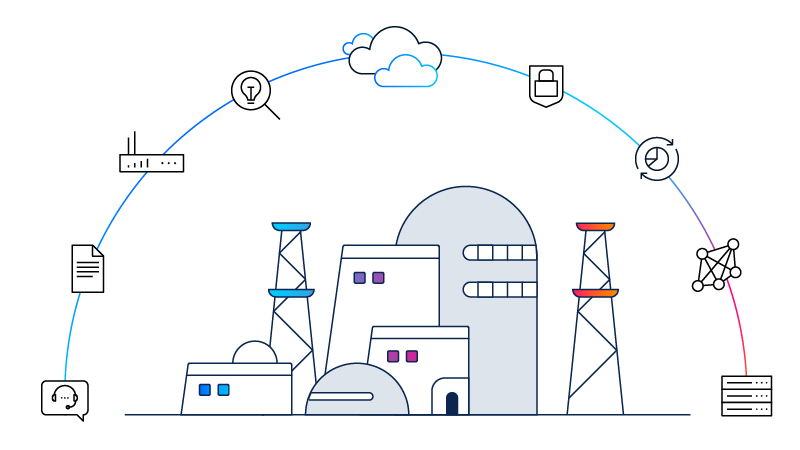
A smart building operates through smart building technology: a continuous cycle of data collection, analysis, and action.
Data collection
Sensors, building systems, and connected devices generate data about conditions such as occupancy, temperature, lighting levels, air quality, equipment status, and access activity.
This data is collected in near real time and shared across a common infrastructure instead of remaining isolated within individual systems.
Data analysis
Collected data is analyzed to establish normal operating patterns and detect changes in conditions. Common patterns include:
- Daily and weekly occupancy cycles
- Temperature and humidity ranges
- Normal energy consumption levels
- Standard equipment run times
Thresholds are defined for conditions that require action, such as maximum room occupancy, acceptable air quality levels, or temperature limits for specific spaces. Current conditions are compared against these baselines. When behavior deviates, for example, energy use remaining high in an unoccupied area or HVAC equipment running longer than expected, the system flags the issue or triggers an automated response.
Action and response
Based on this analysis, the building responds automatically or alerts operators when intervention is required. If a workspace occupancy drops, lighting and ventilation levels may be reduced to avoid running systems at full capacity in unused areas.
This “observe–analyze–respond” loop allows smart buildings to adapt continuously rather than relying on manual adjustments or fixed schedules.
Smart building vs. connected building
The primary difference between a connected building and a smart building lies in how data is used:
- Connected buildings collect and display data from building systems.
- Smart buildings use shared data across systems to automate decisions and coordinate actions.
| Aspect | Connected building | Smart building |
|---|---|---|
| System integration | Systems operate independently | Systems share data |
| Data usage | Monitoring and manual control | Automated, coordinated actions |
| Automation | Limited or system-specific | Cross-system and policy-driven |
| Response to change | Reactive | Adaptive |
| Operational focus | Visibility | Optimization |
Network intelligence and security
Since smart buildings rely on large numbers of connected devices such as sensors, controllers, cameras, and building systems, each device introduces a potential security risk if not properly managed.
Network intelligence continuously identifies devices and analyzes their behavior. Devices are classified based on attributes such as device type, communication patterns, and typical activity levels, establishing a baseline of expected behavior. When a device behaves unexpectedly, such as communicating at unusual times or attempting to access systems outside its normal scope, the deviation is flagged. In some cases, access can be restricted or the device isolated to limit potential impact.
In large buildings with thousands of connected devices, this approach allows security teams to focus on abnormal behavior rather than manually monitoring every endpoint.
Power and connectivity in smart buildings
Smart buildings depend on centralized power delivery (Power over Ethernet - PoE) and network connectivity to support distributed systems at scale. Rather than treating power and networking as separate concerns, modern building designs align them as part of a unified operational approach.
Here are the benefits of this approach:
- Simplify deployment and management: Devices can be installed or relocated where they provide the most value without requiring new electrical work at each location. This reduces installation complexity and long-term maintenance effort.
- Improve operational visibility: Operators can monitor device status, power usage, and network availability from a single management view.
- Support long-term scalability: As buildings evolve, new sensors and systems can be added without redesigning the underlying infrastructure.
Benefits of smart buildings
Smart buildings deliver value by improving how building systems are coordinated and adjusted over time.
Lower operational costs (OpEx)
Real-time data enables dynamic adjustment of lighting, heating, and cooling rather than relying on fixed schedules.
In office environments, lighting levels can be reduced by automatically adjusting window shades to maximize daylight. This would lower electricity use and reduce manual intervention by facilities staff.
Less energy consumption
By coordinating lighting, shading, and HVAC systems, smart buildings align energy use with actual demand. As a result, automated adjustments based on occupancy and environmental conditions reduce unnecessary energy use in low-occupancy areas while maintaining comfort in active spaces.
Greater operational flexibility
Occupancy and density data provide visibility into how spaces are used throughout the day.
In shared workspaces or meeting areas, HVAC systems can respond to increased occupancy by automatically adjusting airflow and temperature, supporting comfort without manual adjustments.
Challenges and limitations of smart buildings
Despite their benefits, smart buildings introduce operational challenges.
Integration complexity
Many buildings combine legacy and modern systems that were not designed to work together. Integrating these systems can be technically complex when data formats or control models vary.
Security considerations
An increased number of connected devices expands the attack surface. Maintaining visibility, segmentation, and access control across diverse devices requires ongoing effort.
Data quality and reliability
Automation depends on accurate data. Faulty or poorly calibrated sensors can weaken system performance, requiring continuous monitoring and maintenance.
Organizational alignment
Smart building initiatives span facilities, IT, security, and operations. Consequently, transparent governance and shared responsibility are necessary to coordinate decision-making and sustain results.
The role of AI in smart buildings
In smart building solutions, AI reduces operational costs by 17.6%, lowers maintenance costs by 13.2%, and achieves energy savings of approximately 14% while maintaining high occupant satisfaction.
Three primary AI capabilities drive these outcomes:
- Prediction: Analyzes historical patterns to anticipate demand
- Optimization: Adjusts system settings to balance comfort and efficiency
- Anomaly detection: Flags abnormal behavior such as unexpected energy spikes or irregular equipment activity
The future of smart buildings
Industry forecasts project the global smart buildings market to exceed $1 trillion by 2035, driven by sustained adoption across commercial and institutional environments.
This growth is supported by measurable outcomes: buildings with data-driven control systems consistently achieve double-digit reductions in energy consumption and quantifiable improvements in operational efficiency.
As these results become more common, future development will place less emphasis on individual technologies and more on scalable, data-driven operations that support efficiency, resilience, and long-term sustainability.